The Power of a Moment: What a Stethoscope Taught Me About Presence
𝙒𝙝𝙖𝙩 𝙙𝙤 𝙮𝙤𝙪 𝙨𝙚𝙚 𝙬𝙝𝙚𝙣 𝙮𝙤𝙪 𝙡𝙤𝙤𝙠 𝙖𝙩 𝙩𝙝𝙞𝙨 𝙨𝙩𝙚𝙩𝙝𝙤𝙨𝙘𝙤𝙥𝙚? ⬇️
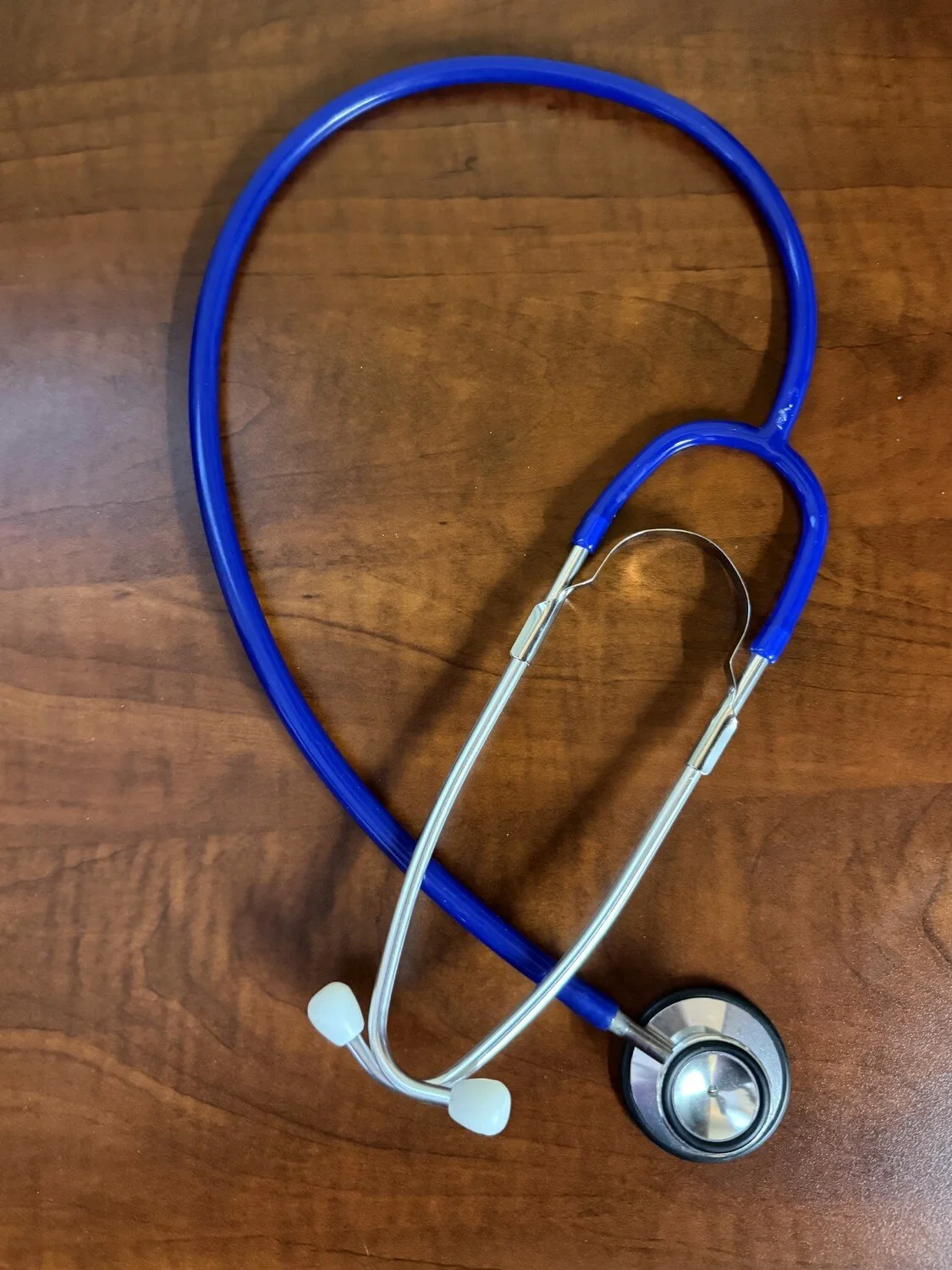
Mom's Sethoscope
Most people would see something disposable. Inexpensive. Easily replaced.
But when I look at this stethoscope, I don’t see a tool. I see a moment — one that has stayed with me for nearly eighteen years.
I see February of 2008.
That was the month my mother was taken ill with what was soon diagnosed as acute respiratory distress syndrome (ARDS). She was admitted to the ICU through the ER in Perry, Georgia — the small town where I grew up.
I rushed to the hospital and camped out in the ICU.
At first, we thought she had pneumonia. But it quickly became clear that her condition was far more serious. She was struggling for every breath she took.
It was hard seeing Mom like this — bedridden and fighting for each breath. She was petite, barely five feet tall and just over a hundred pounds. Yet she was an absolutely formidable force.
Everyone in Perry knew Miss Peggy.
At eighty-three, she walked six miles a day and did aerobics three times a week.
Mom was also hard of hearing and didn’t wear hearing aids.
The next day, they arranged for a pulmonologist from the neighboring town to come see her.
The doctor’s name was Dr. Asad. I still remember his face. I can see it as I write these words.
He was kind, gentle, caring, and deeply compassionate. He spoke with my mother, explaining that he was going to have to intubate her. And understandably, she was scared. Between her labored breathing, her hearing loss, and his accent, she was struggling to fully understand what he was saying.
Then something small and extraordinary happened.
Dr. Asad paused and said, “Excuse me. I’ll be right back.”
He stepped out to the nurses’ station and returned with a stethoscope. This stethoscope. The kind provided in hospital rooms. The kind most people never think twice about.
He gently placed the earpieces in my mother’s ears and used the chest piece as a microphone. Slowly, carefully, he explained the procedure. What he was going to do. Why it was necessary. How he would take care of her.
For the first time, my mother could truly hear him.
Her breathing was still labored. The situation was still serious. But something shifted. Fear softened. Trust entered the room.
Then something even more extraordinary happened.
As Dr. Asad prepared for the procedure, I quietly watched him remove his pager and phone and place them on the nurse’s station desk.
He didn’t announce it.
He didn’t explain it.
He simply set them aside and returned to my mother.
He didn’t even know I saw it.
But those small, unspoken actions communicated volumes.
In that moment, nothing else mattered.
He picked up the stethoscope, explained everything again, asked if she understood and had questions, then intubated her.
A few minutes later, he returned to check on her.
That’s when I stopped him.
I told him what I had seen and what it communicated to me. That in that moment, my mother’s care was the most important thing in the world to him. The only thing receiving his attention.
He smiled, chuckled, and said it cost him a missed stock tip. Then he shrugged it off and went on his way.
But he didn’t stop caring.
Every time Dr. Asad came to see my mother, it was with that same level of presence, compassion, and connection. I thanked him again and again. I even asked once if it was okay to hug him. It was.
Later, I wrote him a letter to express my gratitude.
So when you look at this stethoscope, you may see a five-dollar object.
I see something priceless.
Because that one encounter left an indelible mark on my life.
It taught me the power of a moment. A moment when a healthcare professional slows down long enough to truly connect. Not clinician-to-patient, but human-to-human. Heart-to-heart.
Moments like that don’t end when the room clears or the shift changes. They ripple. They shape how we remember. How we lead. How we care. How we choose to show up when pressure is high and time feels scarce.
Eighteen years later, that moment is still working on me.
Not because it was dramatic. But because it was deeply human.
And it reminds me that the moments we create today may carry far longer than we ever imagined.
A Reflection for You
As you sit with this story, I invite you to pause and reflect:
What moment has stayed with you longer than you expected?
Who showed up for you with presence when it mattered most?
And where might your presence create a moment that quietly ripples forward?
Sometimes the most meaningful impact doesn’t come from doing more — but from being fully present right where you are.
To every healthcare professional who takes the time and has the heart to connect human-to-human and heart-to-heart: you may never fully know what those moments create in the minds and memories of the patients you serve — and their families.
I’M GRATEFUL FOR YOU.