
Last week I asked a simple question:
When sustained pressure builds, what is your first instinct?
56% of leaders said:
Stay quiet and move on.
That response didn’t surprise me.
If you’ve spent time around capable leaders, you’ve probably seen the pattern.
Pressure builds.
And strong people absorb it.
They keep showing up.
They keep delivering.
They keep carrying what no one else sees.
From the outside, it looks like strength.
Inside, something slowly narrows.
Patience.
Perspective.
Sometimes even purpose.
I’ve watched that happen to more than one capable leader.
Especially the one who meets me in the mirror.
My friend Wade Mitzel — the one whose story we began exploring last week — knows that pattern well.
In our conversation, he told me about an email he had to send his team.
His daughter had undergone spinal surgery and suffered a spinal cord stroke. The road ahead was uncertain, and Wade realized something he hadn’t wanted to admit:
At any moment, he might have to step away from work and take her across the country for treatment.
So he wrote to his team and told them the truth.
He let them know he might need to leave quickly.
That he might not be able to fulfill everything expected of him for a season.
For many leaders, that kind of message feels almost impossible to send.
Because it breaks the pattern.
The pattern of staying quiet.
The pattern of carrying it alone.
But what happened next surprised him.
Instead of disappointment, his team responded with something simple:
“We’ve got you.”
Sometimes the first step toward struggling well is letting people see that you’re struggling at all.
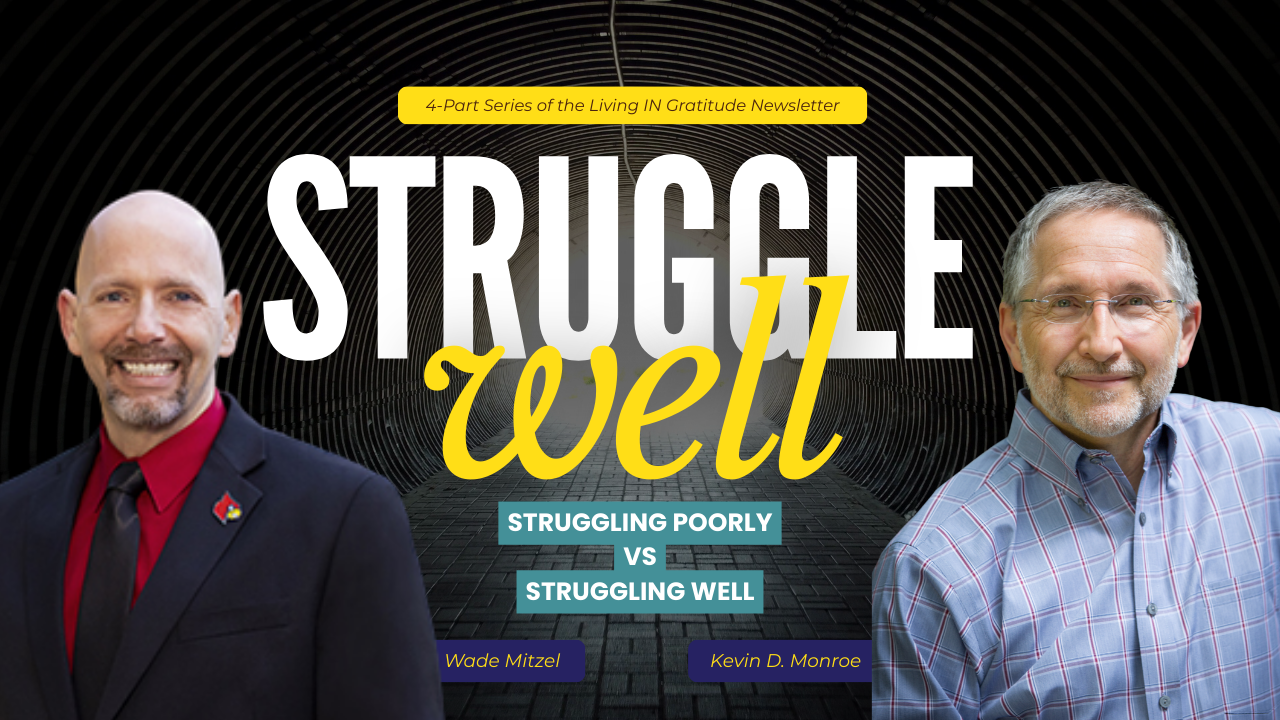
Later in our conversation, I asked Wade what struggling poorly looks like.
He didn’t hesitate.
“When I struggle poorly, it’s the poor-me mindset. I isolate myself. I don’t accept or seek support… and I lose my purpose.”
He began with an admission many leaders avoid:
“Let me first say that I struggle poorly at times as well.”
That kind of honesty is rare in leadership conversations.
Isolation is the quiet signature of struggling poorly.
It doesn’t usually look dramatic.
More often it looks responsible.
Professional.
Composed.
But slowly, something begins to erode.
Perspective narrows.
Relationships grow thinner.
Purpose becomes harder to see.
Organizations rarely fall apart because leaders struggle.
Struggle is inevitable.
What slowly erodes teams is how that struggle is carried.
When pressure stays hidden, people begin to assume they’re supposed to carry their own weight alone too.
Not because anyone said so.
But because that’s the pattern they see.
And over time, silence spreads.
Struggling well doesn’t mean eliminating difficulty.
It begins with something much simpler.
Honesty.
Not oversharing.
Not collapsing publicly.
Just telling the truth about the weight you’re carrying.
That’s what Wade did when he sent that email.
And in doing so, he created something many leaders don’t realize they’re allowed to create.
Space.
Space for others to step in.
Space for people to support one another.
Space for leadership to remain human.
Struggle doesn’t disappear when we acknowledge it.
But it does change shape.
Instead of narrowing us, it can connect us.
Instead of isolating us, it can deepen trust.
Next week we’ll explore a realization that changed how I think about difficult seasons.
That the way we carry struggle doesn’t just determine whether we survive it.
It shapes who we become.
But before we go there, sit with this question for a moment:
Where in your life or leadership have you been quietly carrying something that was never meant to be carried alone?